
B1 is the lightest shade on the VITA Classical tooth shade guide. For a brighter, bleached appearance, BL1 and 0M1 sit at the lightest end of two different shade systems used for dental restorations.
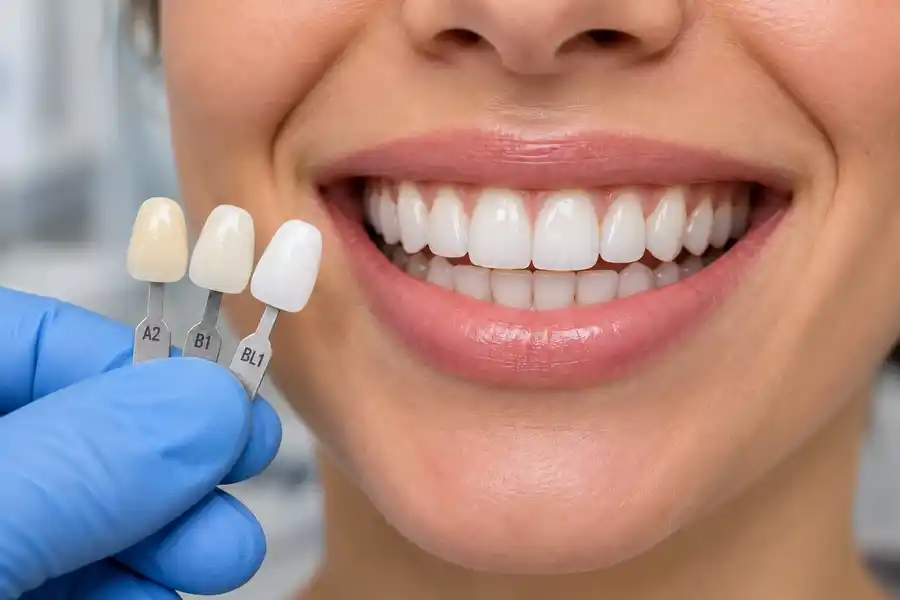
If you are planning veneers or crowns in Antalya, Turkey, these are some of the shade codes you may encounter when discussing your new teeth. But choosing the whitest option on the chart is only part of the decision. Your remaining teeth, the restoration material and the appearance you want all influence the choice.
At Sundent Dental Clinic in Antalya, you can discuss whether you prefer a soft, natural white or a noticeably brighter smile. Photographs help explain your preferences; comparing shade samples beside your teeth helps turn that preference into a colour choice.
What is the whitest natural tooth shade?
Among the 16 shades on the VITA Classical guide, B1 is the lightest. Dentists compare the samples with natural teeth to choose a colour for a restoration. A1 comes next when the tabs are arranged from lightest to darkest.
“Natural shade” describes the range represented by the guide. It does not mean every healthy tooth is B1, or that darker teeth need treatment.
A single tooth can have several shades. The area near the gum often looks warmer, while the biting edge lets more light through. Dentists examine those differences when matching a crown to the teeth beside it.
A1 vs B1: Which tooth shade is whiter?
B1 is lighter than A1. The letter order can be misleading: A comes first alphabetically, but it does not mean A1 is the whitest.
| Feature | A1 | B1 |
|---|---|---|
| Relative brightness | Slightly darker than B1 | Lightest shade in the Classical guide |
| Colour family | Reddish-brown | Reddish-yellow |
| Overall appearance | Light natural | Brighter, yet still natural |
The colour-family names describe subtle undertones, not obviously brown or yellow teeth. Both shades sit near the light end of the guide.
If you are replacing one front crown, the neighbouring teeth guide the choice. Selecting B1 simply because it is lighter can leave that crown looking different from the rest of your smile. With several veneers, the discussion includes the untreated teeth that remain visible beside and below them.
What are BL1 and 0M1 tooth shades?
BL1 belongs to Ivoclar’s BL bleach range. VITA uses codes including 0M1, 0M2 and 0M3 for its bleach shades. These give dentists and dental technicians references for brighter restorations beyond the Classical range.
They are different systems.
BL1 and 0M1 are not interchangeable labels, and an online chart cannot establish an exact match between them. To compare the shades, first check which shade guide and restoration material your dentist uses. The first character in 0M1 is a zero, although many websites write it as “OM1”.
There is another detail behind the colour code: how the restoration handles light. A thin, translucent veneer allows more of the underlying tooth colour to influence the result. A restoration designed to mask a dark tooth behaves differently. To plan the final shade, dentists consider the colour of the underlying tooth alongside the type and thickness of the ceramic.
Will the whitest shade look natural on my teeth?
The whitest shade does not automatically give the most natural-looking result. Nor does a bright shade automatically look fake.
Two veneers on your front teeth can stand out against darker teeth beside them, even when their shape looks natural. Treating more of the teeth that show when you smile gives the dentist more room to create an even colour. The lower teeth still need to be considered.
Opacity makes a difference too. Teeth that look uniformly solid white from the gum to the edge lack the variation seen in natural enamel. Dentists and technicians balance brightness with translucency and surface detail rather than relying on the shade code alone.
Can I achieve my chosen shade with teeth whitening?
Whitening lightens natural teeth, but choosing a target shade does not guarantee that your teeth will reach it. The result depends on your teeth’s original shade and what caused them to become discoloured.
A dentist examines the teeth and existing restorations before discussing whitening. If colour is your only concern and your teeth and gums are otherwise healthy, whitening offers a way to lighten them without removing tooth structure. Choosing veneers or crowns means deciding on more than tooth colour. A wish for a whiter smile is not, by itself, a reason to reshape healthy teeth.
Existing fillings and veneers do not whiten with the surrounding teeth. That matters if you already have visible dental work: whitening can reveal a mismatch that was less noticeable before.
How do I choose a shade for veneers or crowns in Antalya, Turkey?
At your dental consultation in Antalya, show your dentist a few photos of smiles you like. Explain what appeals to you—the brightness, the softer colour or the way the teeth blend together. A photograph communicates your taste, but lighting and filters make it unreliable for choosing an exact shade.
Dentists compare physical shade tabs beside your teeth under suitable lighting. They assess the untreated teeth too. If you are having upper veneers, your lower teeth still influence how white the finished smile looks.
The material also matters. Before bonding ceramic veneers, dentists can use try-in pastes to assess the combined appearance of the ceramic, the underlying tooth and the cement shade. This gives a more useful comparison than looking at a colour chart alone.
Before travelling from the UK to Sundent Dental Clinic in Antalya, Turkey, let the team know what you would like to change about your teeth: their colour, their shape or both. You do not need to arrive with a shade code already chosen. Describe the result you want, then compare the options during your appointment.
Frequently Asked Questions
Is B1 tooth shade too white?
Not necessarily. B1 is a light natural shade, but it can stand out beside darker untreated teeth. The relevant comparison is with the teeth visible in your own smile.
Is B2 tooth shade too white?
B2 is darker than both B1 and A1 on the value-ordered Classical guide. It is not an extreme bleach shade.
Should I whiten my teeth before getting veneers?
If you want to lighten the natural teeth that will remain visible, discuss whitening before the final veneer shade is selected. Dentists allow the whitening result to settle before matching the restorations to it.
Can veneers or crowns be whitened after fitting?
No. Whitening gel does not lighten the ceramic itself. A dentist can remove surface staining where present, but changing the underlying ceramic shade generally means replacing the restoration.