
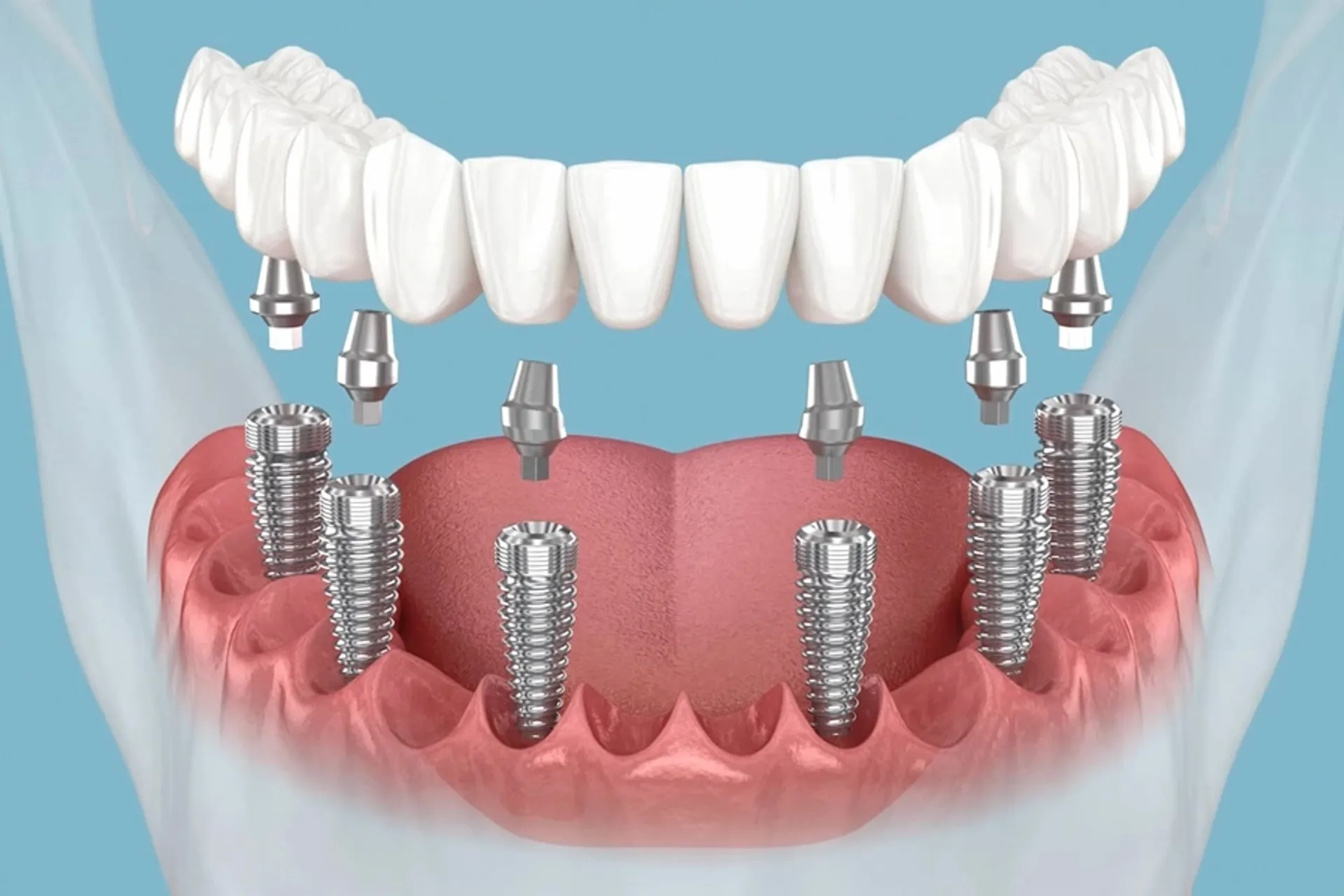
Tooth loss can affect chewing, speech, confidence and everyday life. Thanks to contemporary technology, there are several fixed and removable options for replacing lost teeth. This technique gives patients the chance to eat, smile and speak with confidence. This page explains how All on 6 treatment works, who it may suit and what to expect.
All on 6 method may offer several potential benefits:
- Stability and function: Using six implants may provide additional support compared with All on 4 in suitable cases, especially in the upper jaw where bone density is often lower.
- Support jawbone preservation: Implants stimulate the jawbone like natural tooth roots, which may help reduce bone resorption after tooth loss.
- Less need for grafting: In suitable cases, angled implant placement may reduce the need for bone grafting (bone powder) or sinus lift surgery.
- Natural aesthetics and comfort: Fixed prostheses made with All on 6 method may not cover the palate, which can help preserve taste perception and support speech.
All on 6 procedure may offer economic advantages over typical implant techniques in the rehabilitation of complete tooth loss or end-stage (unrestorable) teeth. These cost benefits are mostly due to the following factors:
- Fewer implants: Conventional full-mouth rehabilitation may require more individual implants to support separate teeth or bridges. All on 6 approach stabilizes the whole dental arch with six implants, which may reduce the cost of surgical procedures and materials.
- Avoiding more surgery: When there is not enough bone volume for conventional implants, further invasive and costly operations like bone grafting (bone powder) or sinus lifts are often required. All on 6 technique places implants deliberately in the densest parts of the bone, which may reduce the need for these additional procedures and the total treatment cost.
- Treatment duration and clinical efficiency: Less surgery and a shorter treatment programme may mean fewer clinic visits and lower overall costs.
- The advantage of immediate loading: Patients may be fitted with their temporary fixed prosthesis on the same day as implant procedure in suitable cases, according to the 'teeth on the same day' protocol. This avoids patients having to spend long recuperation times with detachable dentures or without teeth, minimizing the costs of extra temporary solutions and loss of time.
- Long-term cost-benefit ratio: The long-term function and maintenance needs may influence the overall cost compared with traditional removable dentures or complex single-implant bridges requiring ongoing maintenance.
All on 6 system has the following main elements:
- Dental implants (6 units): These are the six implants that comprise the base of the system. They are placed into the jawbone. These implants are usually made of titanium, a biocompatible material that can integrate with the jawbone during healing.
- Abutments: These are the connectors between the implants and the prostheses. In All on 6 system, multi-unit abutments (MUA) are commonly used to achieve parallelism, particularly when implants are put at an angle, and to facilitate the seating of the prosthesis.
- Fixed dental prosthesis (superstructure): This is the structure that is supported by six implants and represents the full dental arch (upper or lower jaw). The prosthesis is usually fixed to the abutments by means of screws.
- Framework: This is the internal skeleton that gives the prosthesis its strength and stability. This framework can be made from cobalt-chromium alloy, milled titanium, or zirconia, which is of high aesthetic appeal.
- Veneers and teeth: The aesthetic and functional aspect of the prosthesis that can be seen in the mouth. These components are usually fabricated from porcelain (ceramic), zirconia veneers, or composite resin or acrylic teeth.
- Denture screws: These are millimeter-sized screws used to attach the fabricated fixed denture to implants through abutments.
- Temporary titanium cylinders: Auxiliary components for fixing the temporary denture to the implants, particularly in the case of 'immediate loading' procedures, on the day of the surgery.
All on 6 dental implant treatment is a viable rehabilitation option for people who meet certain oral and general health criteria. Patients who may be suitable for this treatment include:
Functional needs and tooth loss
- Total or partial edentulism: Patients who have lost all or a major proportion of the teeth in one jaw.
- Irreversible tooth condition (terminal dentition) - individuals whose existing teeth are classified as 'hopeless' due to severe periodontal disease, widespread decay, or damage and need to be extracted.
- Dissatisfaction with removable dentures: Patients who are unhappy with the stability, retention, discomfort, or problems with chewing and speaking connected with conventional dentures.
Anatomical conditions
- Patients with sufficient bone volume: Ideal candidates are patients with sufficient bone volume and density in the crucial locations where implants will be put.
- Patients with maxillary atrophy: All on 6 approach may be considered, especially for patients requiring maxillary restoration, due to the wider load distribution and stability given by six implants in the maxilla, where bone density is lower.
- individuals who do not want grafting: This approach is excellent for individuals with significant bone loss who do not want to undertake further operations such as bone grafting (bone powder) or sinus lift surgery. This is achieved by using angled implant placement techniques.
Health and lifestyle criteria
- General state of health: Individuals who do not have any serious medical conditions that would prevent them from undergoing surgery, in particular uncontrolled diabetes, autoimmune diseases, or conditions affecting bone metabolism.
- Smoking: As smoking adversely affects the healing process and osseointegration (the fusion of the implant with the bone), smoking status should be assessed before treatment.
- Commitment to oral hygiene: Patients who are committed to maintaining meticulous oral hygiene (using an interdental brush and specialized dental floss) following treatment and to attending regular check-ups with their dentist to ensure the long-term success of implants.
All on 6 treatment is a staged procedure used to treat total edentulism or end-stage tooth loss that requires careful planning and clinical assessment.
Diagnosis and digital planning phase
The first step in treatment is a complete assessment of the patient's overall health and oral and jaw structure.
- Imaging: CBCT (Cone Beam Computed Tomography) and panoramic X-ray are carried out to assess the quantity, quality, and the anatomical structures (sinuses, nerves).
- Three-dimensional (3D) planning: By means of specialized computer software, the best position, angle, and depth for the implants are simulated in a virtual environment.
- Surgical guide preparation: Stereolithographic surgical guides (templates) can be made to accurately transfer the desired positions into the mouth.
Surgical stage
Surgery is usually performed under local anaesthesia, while sedation may be considered after clinical assessment.
- Tooth extraction and preparation: Teeth that cannot be salvaged are extracted. Infections are treated, and if necessary, the bone is rebuilt (alveoloplasty).
- Implant positioning: Six titanium implants are positioned into the jawbone using a surgical guide or a freehand approach. Implants in the posterior region may be placed at an angle of 30–45 degrees to avoid structures such as the sinus and to make full use of the available bone.
- Abutment attachment: Flat or angulated abutments (Multi-Unit Abutment—MUA) that retain the prosthesis are screwed onto the implants and tightened to a predetermined torque.
Temporary prosthesis and immediate loading
One advantage of All on 6 technique is that, in suitable cases, the patient may have teeth restored immediately after surgery.
On the day of the operation or within the following few days, a temporary acrylic bridge is fitted and secured to the implants. This may allow the patient to go through the healing process with temporary fixed teeth.
The osseointegration (healing) process
A waiting period is required for the implants to fuse biologically with the jawbone.
This period typically lasts between 3 and 6 months, though in some cases (depending on the upper jaw or bone quality) it may extend to 8 months. During this period, the patient should eat soft foods and follow the dentist's hygiene instructions.
Final restoration (permanent prosthesis) stage
Once osseointegration is complete, the process moves on to the permanent prosthesis stage.
- Impression taking: The 'open tray' impression technique is generally used to transfer the position of implants to the laboratory accurately.
- Fittings: Fit is checked by taking a bite registration, transferring the facial arch, and carrying out aesthetic wax try-ins and metal/zirconia framework try-ins.
- Delivery: The permanent prosthesis, manufactured from zirconia, porcelain, or hybrid materials, is secured to the implant abutments according to the prosthetic design.
Follow-up and care
Regular professional check-ups and meticulous personal oral hygiene (interdental brushes, specialized dental floss) are vital to ensure the long-term success of the treatment.
All on 6 treatment involves a healing period between implant placement and the fitting of the permanent prosthesis. The main stages of recovery include:
Osseointegration (bone integration) phase
Biological bond: After the implant is placed, the healing process begins. Osseointegration is the process in which the implant becomes integrated with the surrounding jawbone.
Duration: It takes about 3 to 6 months for the implants to fully integrate with the bone. Healing time depends on individual factors, including bone quality and the treatment area.
Bone remodeling: In the first phase, woven bone forms around the implant. This tissue is later replaced by the more organized lamellar bone.
Temporary prosthesis and function
Immediate loading: In suitable cases, the patient may receive a temporary fixed prosthesis on the day of the surgery or shortly after in All on 6 treatment. That means the patient may not need to go through the healing period without teeth.
Soft Tissue Healing: Sutures are routinely removed two weeks post-surgery. It is important that temporary prostheses are carefully fitted to support soft-tissue healing without excessive pressure.
Aftercare during healing
The outcome of the treatment depends directly on the habits and care of the patient during the healing time.
Oral hygiene
- Good oral hygiene is important to reduce the risk of inflammation around the implant (peri-implantitis).
- Along with routine brushing, the use of interdental brushes and special floss (super floss) is necessary.
- Regular professional check-ups are essential to manage any build-up of plaque surrounding the implant.
Diet
- A soft diet should be followed during the healing (osseointegration) process to prevent excessive stress on the implants.
- Avoiding hard foods whilst wearing a temporary prosthesis both protects implant integration with the bone and prevents the prosthesis from breaking.
Lifestyle and systemic conditions
- Smoking: Tobacco products adversely affect bone and soft tissue healing, thereby increasing the risk of implant failure.
- Systemic diseases: Uncontrolled diabetes and immune system disorders can slow down the healing process and may increase the risk of peri-implantitis.
Regular check-ups
Regular dental check-ups should be attended at intervals recommended by the dentist. During these check-ups, implant stability and prosthesis fit are monitored.
| Feature | All on 4 | All on 6 |
|---|---|---|
| Number of Implants | 4 implants (2 straight, 2 tilted) | 6 implants (can include tilted) |
| Clinical considerations | May be considered when posterior bone is limited | May be considered when adequate bone is available |
| Stress Distribution | Distributed across four implants | Distributed across six implants |
| Bone Quality Requirement | Can work with less volume | Requires adequate bone in the planned implant sites |
| Cantilever Length | May involve a longer cantilever, depending on the treatment plan | May allow a shorter cantilever, depending on the treatment plan |
| Mechanical Risk | Higher risk of screw/prosthetic failure | Mechanical complications can occur and depend on the treatment plan and aftercare |
| Oral Hygiene | Cleaning needs depend on the prosthetic design | Cleaning needs depend on the prosthetic design |
| Bone Resorption Control | May support bone stimulation | May support bone stimulation |
| Cost | More cost-efficient (fewer parts) | Higher initial cost (more components) |
Factors affecting cost:
Below are the main elements that affect the cost of All on 6 treatment:
- Implant brand and quality: The brand of the implant used (for instance, premium Swiss brands such as Straumann or Nobel Biocare compared with other alternatives) significantly affects the cost. Treatments with Nobel or Straumann products will be more expensive.
- Material of the prosthesis: The price is also affected by the material of the permanent teeth. Zirconia is an elegant and durable, high-quality material. It is more expensive than metal options with acrylic or porcelain veneers.
- Other surgical procedures: Not all patients have the same bone structure. If the patient's jaw bone is not dense enough, several preliminary treatments may be required, such as bone grafting or sinus lift surgery, to prepare the area for the implant. These extra procedures add to the total cost.
- Clinic and dentist expertise: The price is also affected by the clinic's location, its technical infrastructure, and the experience and qualifications of the dentist who will perform the procedure.
All on 6 cost comparison by country
| Country | Estimated Cost (EUR) per Arch |
|---|---|
| Turkey | €4,200 – €8,400 |
| UK | €21,300 – €33,100 |
| USA | €25,800 – €36,900 |
| Germany | €22,000 – €35,000 |
Prices are per arch and may vary depending on the implant brand, prosthetic material and any additional procedures required.
What are All on 6 dental implants?
It involves placing six implants in a jaw with complete tooth loss or where the remaining teeth need to be extracted in order to create a fixed dental prosthesis.
Who may be suitable candidates for this treatment?
Patients who have lost most or all of their teeth and whose general health is suitable for surgery may be suitable candidates.
Is there any pain during All on 6 treatment?
As the procedure is carried out under local anaesthesia or sedation, pain is usually minimised during the procedure.
How long does All on 6 treatment take?
Implant placement may take a few hours; however, a waiting period of 3–6 months is required for osseointegration (fusion with the bone).
Can I have my teeth fitted on the same day?
In suitable cases, immediate function can be restored by fitting temporary fixed prostheses on the day the implants are placed.
How long do All on 6 implants last?
Titanium implants are designed for long-term use with proper oral hygiene and regular check-ups.
Is there a difference between the upper and lower jaws?
Yes, the upper and lower jaws differ in bone structure. The number of implants depends on the available bone, bite and treatment plan.
Can patients with diabetes undergo All on 6 treatment?
Patients with well-controlled diabetes may be considered for implant treatment after individual assessment; however, uncontrolled diabetes may adversely affect healing.
Does smoking affect All on 6 treatment?
As smoking slows down bone healing, it increases the risk of the implant failing to integrate with the bone.
Can this treatment be used for patients with osteoporosis?
Osteoporosis and any related medication should be assessed individually before implant treatment. The need for bone grafting depends on the available bone and treatment plan.
What material is the final prosthesis made of?
Zirconia, metal-porcelain, or, in some cases, acrylic/composite hybrid materials are generally used.
How are All on 6 prostheses cleaned?
They should be brushed twice daily. Special dental floss (super floss) and interdental brushes should also be used for the areas under the bridge.
What can I eat after treatment?
A soft diet is recommended during the healing (osseointegration) period; the return to normal chewing should follow the dentist’s advice.
Can an implant fail?
Implant 'rejection' is rare; failure is usually due to infection, excessive loading, or poor bone quality.
How is All on 6 different from All on 4?
All on 6 uses two additional implants. The most suitable approach depends on the available bone, bite and individual treatment plan.
Will there be swelling after the operation?
Mild swelling or bruising can occur after surgery and usually improves over the following days. Your dentist will advise you on suitable aftercare.
Will All on 6 affect my speech?
As it is fixed in place, speech may improve compared with unstable removable dentures after an adjustment period.
Are regular check-ups necessary?
Yes, dental check-ups and professional cleaning at intervals recommended by the dentist are important for long-term success.
Can I undergo All on 6 treatment while pregnant?
All on 6 treatment is usually postponed during pregnancy because it is an elective surgical procedure. The most appropriate timing should be decided with your dentist and obstetrician.