
Tooth loss can affect chewing, speech, confidence and everyday social life. Removable dentures remain suitable for some patients, but they may move during eating or speaking. All on 4 treatment may provide a fixed full-arch option for people who have lost most or all of their teeth, or whose remaining teeth cannot be retained.
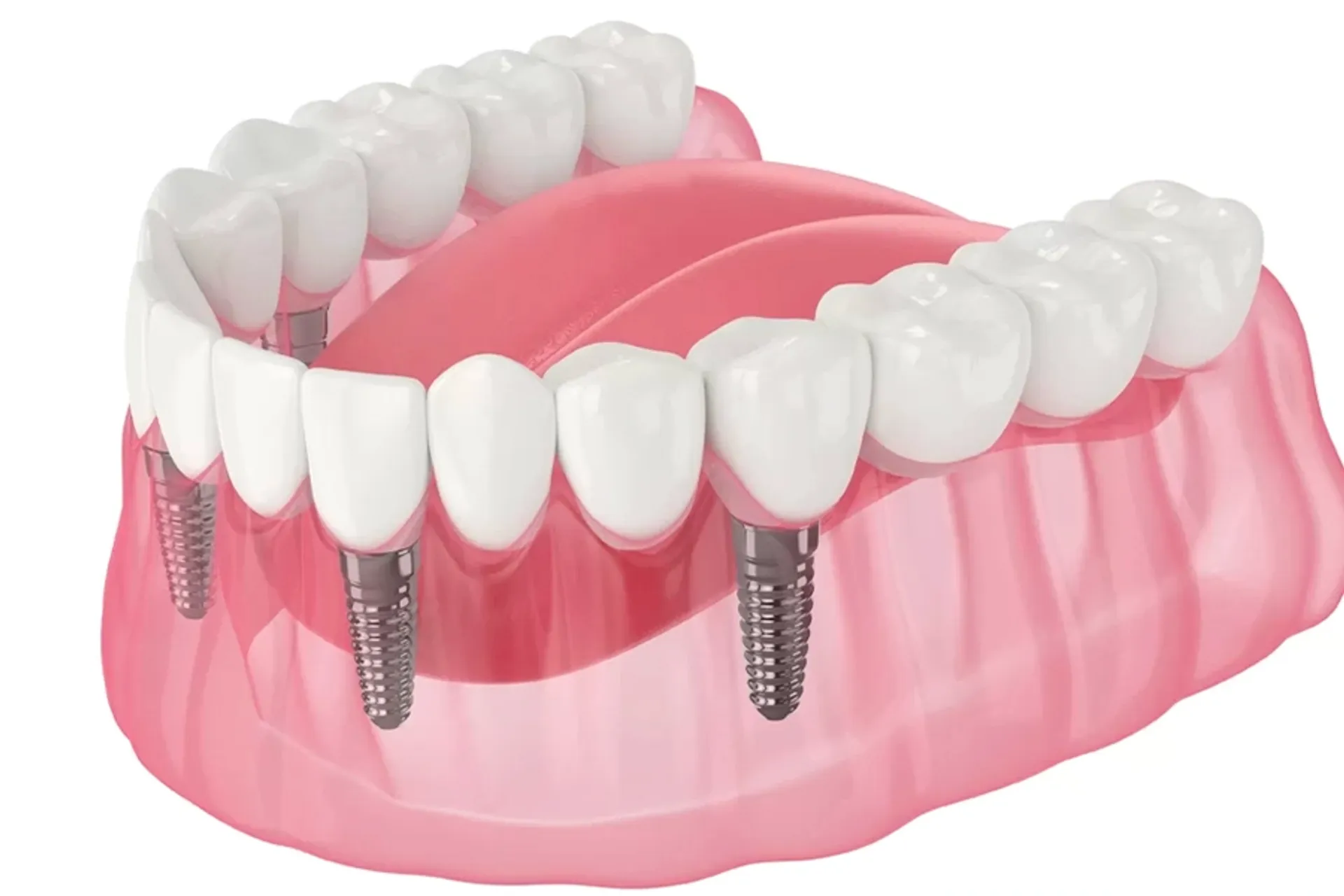
All on 4 is a procedure that involves securing an entire row of teeth to only four titanium implants placed in planned positions within each jaw arch. The angle of the implants is the fundamental element that distinguishes this approach from traditional methods. The two implants in the rear are inserted at an angle of up to 45 degrees; the two implants in the front are inserted vertically.
This angled position can help the dentist make use of the available bone towards the front of the jaw. It may reduce the need for bone grafting in suitable patients, although this can only be determined after clinical examination and three-dimensional imaging.
Main components of All on 4 dental implants
The All on 4 system essentially consists of three main components and the auxiliary parts that connect them:
- Titanium implants (artificial roots): Four titanium screws are surgically placed into the jawbone to support the full-arch restoration. Titanium is biocompatible, and the implant surface can integrate with the surrounding bone during healing.
- Abutments: These are connector pieces screwed onto the implants that link the implants to the prosthetic teeth. Multi-unit abutments are specifically used in this system. Depending on the angle of the implants and the thickness of the gum tissue, straight and 17° or 30° angled options are available.
- Fixed bridge (prosthesis): This is the visible part of the system and restores the function and aesthetics of natural teeth. Two types of bridges are used during the process: a temporary acrylic bridge fitted on the day of surgery and a permanent (final) bridge—made from materials such as zirconia, porcelain, or composite—fitted after healing.
Additional components of All on 4
- Fixation screws: These are special abutment and prosthesis screws that secure the bridge to the abutments and the abutments to the implants.
- Temporary copings: These are titanium or plastic components that ensure the prosthesis fits securely and is firmly fixed onto the abutments.
- Laboratory components: These include impression copings, implant analogues (replicas), and guide components used by the dental technician when fabricating the prosthesis.
In the All on 4 approach, the two posterior implants may be placed at an angle of up to 45 degrees. This position can make better use of the available bone and may reduce the need for additional procedures in suitable cases. The main reasons for angled placement include:
- You don't need a ton of bone: By angling those back posts, you have a lot more surface area for the bone to really grab onto. So even if someone has lost a lot of bone over the years, you can still obtain a fairly good, steady hold without any problems.
- It avoids the danger zones: the tilt helps you steer away from the difficult regions in the mouth. You don't want to hit the sinuses in the upper jaw, and you need to look out for the major nerve in the lower jaw. "You just go right by them safely, angling the implants."
- No painful bone grafts You're angling the implants forward into the thicker, stronger bone in the front of the jaw so you usually don't have to bother with bone powder or grafting. For the patient, that means avoiding a full extra pricey procedure with a long recovery time.
- Chewing feels normal: The implants are spaced out farther along the jaw so the pressure is distributed a lot better when you bite down. It distributes the force across the full bridge instead of putting too much force on one location.
- No ridiculous overhangs: If the rear implants went straight up, the very end of your new teeth would just be hanging out in midair (a cantilever, in doctorspeak). That puts a hell of a strain on the bridge and can snap it. Tilting those back implants shortens that space, making the whole system a lot stronger and less likely to break.
- A smile, just four postings for The layout is just so efficient. So you need only four implants in total to secure a full bridge of up to 12 teeth. It makes the procedure basic yet provides you a permanent, fully fixed set of teeth.
The main differences between the All on 4 and All on 6 treatment approaches are the number of implants, the level of support, and the suitability of the patient's jawbone structure. The differences between the two procedures are as follows:
- Number of implants: The most evident difference is the number of titanium posts used to support each dental arch: the All on 4 system uses 4 implants, while the All on 6 system uses 6.
- Support and stability: The All on 6 system has more implants, so it gives more support, stability, and anchor points for the prosthetic dental arch. The two additional implants spread the chewing forces more evenly over a larger area of the jawbone.
- Bone needs: All on 6 treatment usually requires greater bone volume and density. On the other hand, All on 4 can offer a solution even in patients with limited bone volume by avoiding the necessity for bone grafting (bone powder) due to the angled positioning of the implants in the posterior region.
- Surgical process and recovery: All on 4 is less invasive (needs less surgical intervention) than All on 6 because it uses fewer implants. This can shorten the procedure and improve patient comfort.
- Cost: All on 4 is often seen as the more affordable choice, as it relies on fewer implants and parts than All on 6.
Neither All on 4 nor All on 6 is automatically better for every patient. The choice depends on jawbone structure, bone density and individual clinical needs. Both approaches may support temporary fixed teeth on the day of implant placement when implant stability and other clinical conditions allow.
Here's a comparison to help you figure out which choice could be right for you:
When Is All on 4 a better choice?
- Limited bone volume: In cases of considerable bone loss in the jaw, particularly in the posterior areas, All on 4 is an appropriate treatment. In this way the posterior implants are placed at a 45-degree angle to best leverage the existing bone.
- Avoiding bone grafting: Due to the angled placement, bone grafting (addition of bone powder) or sinus lift treatments may not be necessary in some cases. These procedures are often labour-intensive and costly.
- Less invasive surgery: With fewer implants (4), the surgical area is more confined, and therapy is faster and less intrusive.
- Cost-effectiveness: All on 4 may be a more affordable alternative to standard procedures that need 8 to 10 implants.
When is All on 6 a better choice?
- Adequate bone density: If the patient has enough jawbone volume and density to sustain six implants, All on 6 may be the better choice.
- Greater stability and support: The All on 6 system offers an increased number of anchor points for the prosthetic dental arch. This helps to distribute chewing forces more evenly over a greater area of the jawbone.
- Increased feeling of security: The increased number of implants helps to improve the stability of the prosthesis, offering additional support, especially for patients with powerful chewing muscles.
How does a CBCT scan help choose between All on 4 and All on 6?
The most reliable way to determine which system is right for you is to have a thorough check-up by your dentist. Your dentist will take a CBCT (computed tomography) scan to assess the quantity and quality of your jawbone and will then digitally plan the best positions for the implants.
All on 6 uses two additional implants and may provide more support when sufficient bone is available. All on 4 may be considered for some patients with limited posterior bone, but the need for bone grafting must be assessed individually.
Who may be suitable for All on 4 treatment?
| Criteria | Description |
|---|---|
| Edentulism Status | Patients who have lost all teeth in one or both jaws, or whose remaining teeth need to be extracted. |
| Bone Structure | Patients with sufficient bone volume in the anterior (front) region of the jaw. The main advantage of this technique is that it can often be performed using the available bone in the front, even when bone in the posterior (back) region is limited. |
| General Health | Patients classified as ASA I or ASA II according to the American Society of Anesthesiologists (ASA) classification, meaning they have no systemic disease or have mild, well-controlled conditions. |
| Oral Tissues | Patients with healthy oral soft tissues (gums, mucosa) that are free from infection. |
Unsuitable candidates for All on 4
| Criteria | Description |
|---|---|
| Uncontrolled Systemic Diseases | Patients with uncontrolled diabetes, osteoporosis, hyperparathyroidism, or other conditions that directly affect bone metabolism. |
| Bone-Related Special Conditions | Patients who have received radiation therapy to the head and neck or have conditions affecting bone healing require individual assessment. Patients taking bisphosphonates or other antiresorptive medicines must discuss the medication, dose and method of administration with the dentist before suitability can be determined. |
| Severe Habits and Conditions | Smoking, high alcohol intake and substance use may impair healing and increase the risk of implant complications. These factors should be discussed during the assessment and managed before treatment where possible. |
| Oral and Jaw Problems | Severe teeth clenching or grinding, poor oral hygiene and difficulty following long-term aftercare may increase the risk of complications. These factors must be assessed and managed before All on 4 treatment is planned. |
| Surgical Risks | Patients with bleeding disorders, haematological diseases, or conditions that suppress the immune system. |
| Temporary / Non-Definitive Conditions | Conditions such as pregnancy or the presence of active infection in the treatment area require postponement of the procedure. |
All on 4 treatment involves several clinical and laboratory stages, from the initial assessment to the fitting of the permanent restoration. The exact process depends on the condition of the teeth, gums and jawbone. Temporary fixed teeth may be fitted on the day of implant placement when clinical conditions allow. The main stages include:
All on 4 assessment and digital planning in Antalya
The dentist starts with an intraoral examination and an assessment of the bone structure.
- Imaging: CBCT (computed tomography) and X-rays are taken to assess the patient's jawbone volume and density.
- Digital simulation: Based on the 3D images obtained, digital software is used to plan the positions, angles and depths for the implants.
- Model fabrication: Before surgery, models are fabricated from the patient's existing dentition or designed to represent the intended new teeth.
All on 4 implant surgery in Antalya
The treatment is usually performed under local anaesthesia, while sedation may be considered after an appropriate clinical assessment.
All on 4 healing and osseointegration
A period of around 3 to 6 months is generally required for the implants to fuse with the jawbone, although healing time varies.
- Diet: During this stage, the patient is advised to eat soft foods to prevent excessive strain on the implants.
- Tissue healing: The healing of the gums and the stabilisation of the bone structure continue during this period.
Fitting the permanent All on 4 restoration
Once healing is complete, the patient is fitted with their final teeth, which are designed for long-term use.
- Impression and preparation: The temporary bridge is removed and new impressions are taken.
- Permanent bridge: The permanent prosthesis, made from highly durable materials such as porcelain, zirconia, or composite mounted on a titanium framework, is screwed onto the implants.
- Final check: The treatment is completed following a check of the bite force and aesthetic appearance.
The recovery period and aftercare routine are important for a successful outcome for your All on 4 treatment and support the long-term function of your new teeth. The following points should be considered during recovery:
All on 4 healing timeline
- Duration: The titanium implants generally take around 3 to 6 months to integrate with the jawbone.
- First few days: It is common to experience some redness, swelling, and mild discomfort in the surgical area for the first few days after the procedure.
- Speech: When the prosthesis is first placed, a temporary lisp may occur, but the tongue will adjust to the new structure within a few days.
What to eat after All on 4 implant surgery
- Soft diet: You must consume only soft meals until the implants have merged with the bone completely (first 3-6 months).
- The first two weeks: Avoid hard and brittle foods. Instead, choose puréed foods that do not stress the implants.
Avoid chewing ice; hard sweets; cracking nuts such as hazelnuts or walnuts with your teeth; or eating highly sticky meals since this puts too much stress on the implant posts and can lead to failure of the system.
How to clean All on 4 dental implants
The hygiene schedule depends on the stages of healing:
- 0–14 days: The surgical areas are quite sensitive. Instead of brushing, you should gently gargle with warm salt water 3–4 times a day. During this time you should avoid using a water flosser or interdental brush.
- 2–12 weeks: You may use a soft toothbrush and a low-pressure water flosser (oral irrigator) once the gums have started to mend.
- After final prosthesis placement: Brushing twice daily and use of an oral irrigator and Super Floss (special dental floss for cleaning beneath bridges) once a day should be continued for life.
Lifestyle and risk factors after All on 4 treatment
- Smoking: Smoking can interfere with osseointegration (the union of the implant with the bone) and significantly increases the risk of infection. It is therefore advisable to avoid smoking during treatment.
- Teeth grinding (bruxism): If you grind your teeth, it is imperative that you wear the sleep guard your dentist recommends to balance the vertical forces on the implants.
- Warning signs: Bad breath, a metallic taste, bleeding gums, or persistent swelling around your implants may indicate peri-implantitis (inflammation around the implant), and your dentist should be consulted without delay.
Professional care and check-ups for All on 4 implants
Cleaning your teeth at home alone may not be sufficient. You need to attend regular dental check-ups to examine the stability of your implants and to remove tartar from hard-to-reach locations.
| Category | Main Disadvantages |
|---|---|
| Mechanical | Screw loosening or fracture, prosthesis fracture / cracking / wear |
| Biological | Peri-implantitis (inflammation around the implant), implant loss, bone resorption, gum recession, loss of sensation |
| Aesthetic / Functional | Bulky prosthesis feel, speech difficulties, chewing problems, deviations from natural appearance |
| Surgical / Patient-Related | Infection, bleeding, swelling, nerve damage (numbness, tingling), sinus issues; smoking, uncontrolled diabetes, poor oral hygiene increase risks |
What affects All on 4 dental implant costs?
The following factors influence the final treatment cost:
- Materials used: Prices vary depending on whether the permanent (final) prosthesis is acrylic or composite-coated titanium, zirconia or ceramic.
- Additional surgical procedures: The All on 4 treatment may reduce the need for bone grafting (bone powder), but in cases of significant bone loss, additional procedures or zygomatic (cheekbone) implants may be necessary, which can add to the cost.
- Expertise and technology: The cost reflects the experience of the dentist who performs the procedure and the use of advanced technologies such as CBCT (3D tomography) scans and computer-guided surgery (NobelGuide).
Is All on 4 cost-effective in the long term?
Although All on 4 may appear to be a high initial cost, its long-term cost depends on maintenance and future prosthetic needs:
- Durability: Designed for long-term use, it may reduce the need for replacement or frequent adjustments compared with removable dentures.
- Cost-effectiveness: Using just 4 implants instead of 8–10 individual implants reduces both the surgical procedure and component costs compared to traditional full-mouth implant treatments.
All on 4 cost comparison by country
| Country | Estimated Price Range (Euro) |
|---|---|
| Turkey | €2,800 - €6,500 |
| United Kingdom | €12,000 - €25,000 |
| USA | €15,000 - €30,000 |
What are All on 4 dental implants?
It is a treatment method in which a fixed full-arch restoration is supported by four implants placed in a single jaw arch.
How are All on 4 implants different from removable dentures?
All on 4 is fixed, does not move around in the mouth, requires no adhesive, and functions like natural teeth.
Is All on 4 dental implant surgery painful?
As the surgical procedure is carried out under local anaesthetic or sedation, pain is usually minimised during the procedure; however, there may be some mild swelling and tenderness afterwards.
Is 'teeth in a day' really possible?
In suitable cases, temporary fixed teeth may be fitted on the day the implants are placed.
Who is suitable for All on 4 dental implants?
Most adults in good general health with sufficient jawbone are suitable candidates. Suitability is determined by a CBCT scan.
Will I need a bone graft for All on 4 dental implants?
Thanks to the angled placement of the posterior implants in the All on 4 procedure, the need for a bone graft may be reduced in some patients.
How long do All on 4 dental implants last?
With proper care and hygiene, the implants are designed for long-term use.
When are permanent All on 4 teeth fitted?
Permanent (final) prostheses are fitted after a waiting period of 3–6 months to allow the implants to integrate with the bone.
What materials are used for All on 4 prostheses?
Temporary teeth are usually made of acrylic, while permanent ones are made of more durable materials such as porcelain, zirconia, or composite.
Can All on 4 dental implants become infected?
Yes, if hygiene is neglected, a gum disease known as peri-implantitis may develop around the implant.
Can All on 4 dental implants affect speech?
You may experience slight slurring for the first few days, but your speech will return to normal once your mouth has adjusted to the new teeth.
Do All on 4 dental implants require professional cleaning?
Yes, professional implant care should be carried out at intervals recommended by your dentist.